Did you know that "budget" fitness gear can cost you up to three times more over a five-year period than professional-grade machinery? That low sticker price at a big-box retailer is often just a down payment on the hidden costs of buying cheap fitness equipment. Between mid-workout breakdowns, wobbly frames that compromise your safety, and zero resale value, the financial drain is real. You want a gym that lasts a decade, not a machine that ends up in a landfill by next season.
You likely believe that professional-grade gear is out of reach, but you’re tired of equipment that shakes when you sprint. This 2026 buyer’s warning reveals how to secure elite biomechanics and rugged durability without the astronomical new-product markup. You’ll learn how to leverage the $2,560,000 Section 179 tax deduction and 100% bonus depreciation to your advantage. We’ll also break down how to offset the 10% global import surcharges by investing in refurbished Life Fitness and Precor hardware that actually holds its value.
Key Takeaways
- Learn why the initial sticker price is a misleading metric and how to escape the expensive cycle of buying and replacing unreliable home gear.
- Identify critical structural differences between residential tubing and 11-gauge commercial steel to ensure your equipment remains stable and safe for years.
- Uncover the hidden costs of buying cheap fitness equipment, including the time and money lost to maintenance and the frustration of sourcing obsolete components.
- Master a professional 2026 evaluation checklist that focuses on user weight capacity and frame integrity to distinguish true value from low-quality gimmicks.
- Discover how to secure elite, commercial-grade refurbishments from industry-leading brands at a fraction of the cost of buying new.
Table of Contents
The Cheap Equipment Trap: Why Sticker Price is Misleading
The "Cheap Equipment Trap" is a relentless cycle that many fitness enthusiasts fall into. You buy a low-cost machine from a big-box store, it breaks within eighteen months, and you’re forced to buy another. This pattern reveals the true hidden costs of buying cheap fitness equipment. While consumer-grade models look shiny in the showroom, they lack the structural integrity of professional types of exercise machines found in elite health clubs. Professional gear is built for continuous use; budget gear is built for a price point.
The toll isn’t just financial. Unreliable gear creates a psychological barrier to consistency. When your frame wobbles or the belt slips, your focus shifts from performance to safety. Eventually, that broken machine becomes an expensive clothes rack, killing your momentum and your fitness goals. Reliability is the foundation of a successful home gym.
The ‘Disposable Fitness’ Phenomenon
In 2026, manufacturing trends have shifted toward planned obsolescence for entry-level gear. Many budget brands use thin-walled tubing and proprietary plastic components that don’t allow for easy repair. This creates a massive environmental burden as discarded frames end up in landfills. These manufacturers often don’t maintain a robust supply chain for replacement parts. This means a single failed sensor or a snapped plastic bracket can render your entire investment useless.
Sticker Price vs. Lifetime Investment
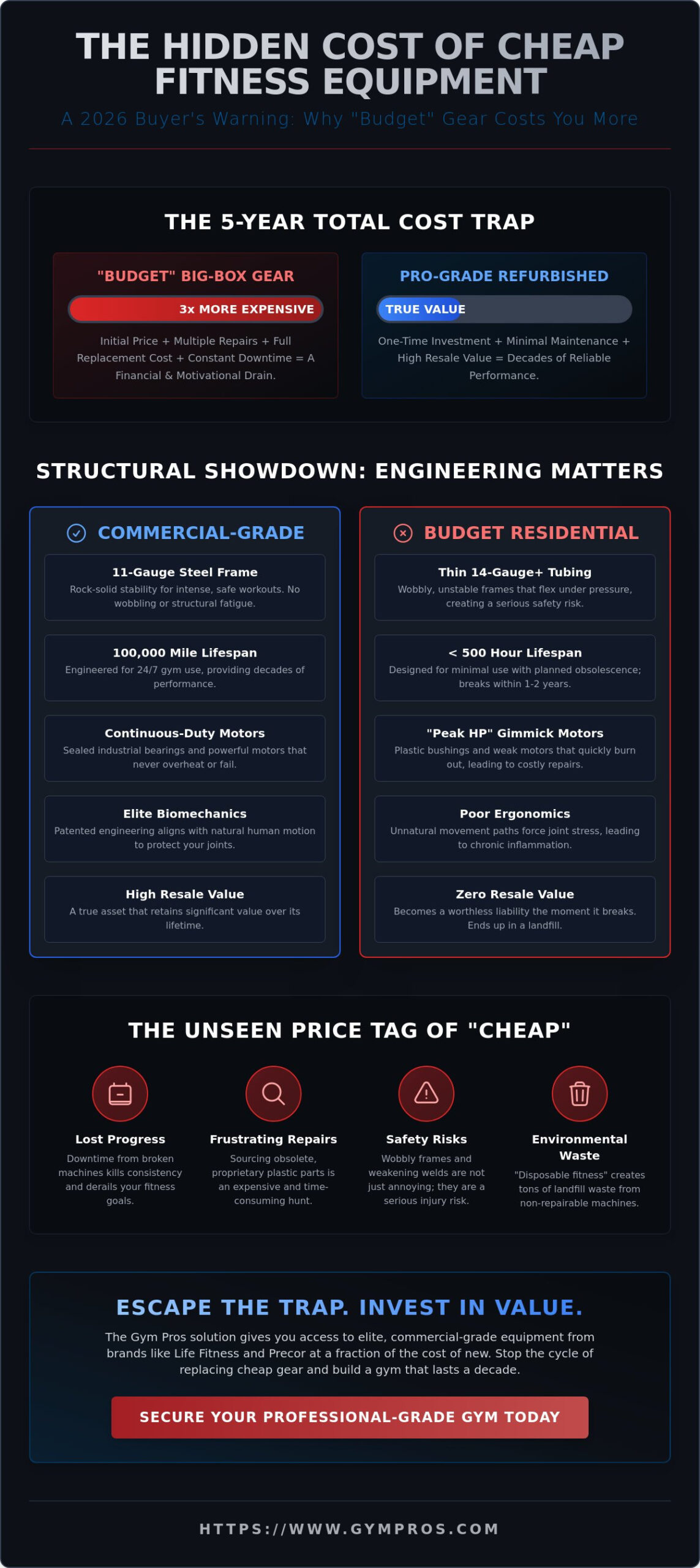
Compare the lifespan of a generic $400 treadmill to a refurbished Life Fitness treadmill. Professional units are engineered for 100,000 miles of use; budget models are lucky to survive 500 hours. You must also account for "downtime" costs. Every week your machine sits idle is a week of lost progress. Total Cost of Ownership (TCO) is the combined sum of the initial purchase price, ongoing maintenance expenses, and the asset’s depreciation over time. Investing in Precor treadmills or similar commercial units ensures you aren’t just buying a product, but securing a decade of performance.
The Engineering Gap: Biomechanics, Steel, and Safety
Steel is the skeleton of your gym. Most commercial machines are built with 11-gauge steel, a heavy-duty material designed to withstand thousands of pounds of force without flexing. In contrast, big-box retailers often sell equipment made from 14-gauge or thinner residential tubing. This thinner metal lacks the mass to remain stable during high-intensity intervals. That "wobble" you feel isn’t just a nuisance; it is a sign of structural fatigue. Over time, those micro-movements weaken welds and strip bolt threads. Dealing with these failures is one of the primary hidden costs of buying cheap fitness equipment.
The internal components are equally disparate. Commercial treadmills feature motors with a high continuous-duty cycle, meaning they can run for hours without overheating. Cheap motors are often rated by "peak horsepower," a misleading metric that doesn’t reflect sustained performance. When a low-grade motor struggles under load, it draws more current and eventually burns out the control board. Similarly, professional equipment uses sealed industrial-grade bearings. Budget alternatives often rely on plastic bushings that degrade rapidly, leading to the grinding noises and jerky resistance common in entry-level ellipticals.
Biomechanics and Joint Health
Poor engineering forces your body into unnatural movement paths. If a machine’s pivot points don’t align with your joints, you’re trading cardiovascular health for chronic inflammation. High-end treadmill decks use advanced elastomers to manage impact absorption, protecting your ankles and lower back. Following Exercise physiologists’ advice, you should prioritize gear that supports natural human motion. For example, Precor Ellipticals are world-renowned for their patented biomechanics that mimic the body’s natural running gait while eliminating joint impact.
Safety Risks You Can’t Ignore
Safety shouldn’t be a gamble. In 2026, the rise of "disposable" fitness gear has led to increased reports of deck cracking and cable snapping during heavy use. Commercial-grade units must pass rigorous UL 1647 and EN957-H certifications to ensure they won’t fail under stress. Cheap electronics are also prone to short-circuiting when pushed to their limits. If you want a machine that remains rock-solid and safe after a decade of use, consider browsing the verified inventory at Gym Pros for hardware that meets true professional standards.
Calculating the Real 5-Year Cost of Fitness Gear
When you evaluate a purchase, don’t look at the sticker. Look at the calendar. Over a five-year horizon, the hidden costs of buying cheap fitness equipment become painfully clear through recurring repair bills and the "search for parts" tax. Budget manufacturers frequently cycle through component designs, making it nearly impossible to find a replacement console or motor for a three-year-old machine. Your time spent hunting for obsolete parts has a dollar value, and it’s a cost you never pay with established commercial brands.
Professional installation also plays a critical role. Most budget gear is shipped in pieces for DIY assembly. Misaligned frames and improperly tensioned belts lead to friction that burns out motors early. Commercial-grade units are engineered for high-intensity environments, meaning they require far less intervention to stay operational. When you choose professional-grade hardware, you’re investing in uptime.
Maintenance and Repair Fees
Generic service calls often require specialized technicians who charge a premium for working on non-standard hardware. Budget brands often use low-quality, custom electronics that can’t be swapped with universal components, creating a "proprietary part trap." You end up paying more for a simple circuit board than the machine’s depreciated value. Securing one of our Extended Warranty Plans ensures these long-term operational risks are managed by experts, protecting your capital from unexpected spikes in maintenance spending.
The Depreciation Gap
The math on resale is staggering. A budget treadmill is often worth less than 10% of its original price on the secondary market after just 24 months. It’s an expense that simply disappears. In contrast, a refurbished Life Fitness Treadmill is a durable asset. These machines typically retain 50% to 70% of their value because the market recognizes their 20-year lifespans. By 2031, a professional unit will still be a functional piece of machinery with a high trade-in value, while the budget alternative will likely be at a local recycling center.
How to Spot ‘Value’ vs. ‘Cheap’ (A 2026 Checklist)
Identifying the hidden costs of buying cheap fitness equipment requires looking past the aesthetic design and focusing on the industrial specs. You aren’t just buying a machine; you’re acquiring a performance asset. To ensure you’re making a savvy investment, use this five-step verification process before finalizing any purchase.
Step 1: Check User Weight Capacity. If the limit is under 350 pounds, it’s residential gear. True commercial units are rated for 400 pounds or more, signifying a more robust drive system and frame.
Step 2: Inspect Frame Construction. Look for continuous welds at the major joints. Excessive bolting is a sign of a machine designed for cheap shipping, not for structural longevity or rigidity.
Step 3: Research Brand Pedigree. Verify if the brand is a staple in high-traffic health clubs. Names like Star Trac are benchmarks for durability because they’re engineered to survive 12 hours of daily use.
Step 4: Evaluate the Warranty. A "parts-only" warranty is a red flag. Labor is often the most expensive component of a repair, so insist on coverage that includes professional service.
Step 5: Consider the Source. A random reseller offers "as-is" risk. An authorized refurbisher provides a verified restoration process that protects your capital.
Commercial vs. Residential Standards
The industry defines "Commercial" as equipment engineered to handle 12 or more hours of daily operation. Most home users don’t need that level of volume, which is why "Light Commercial" gear is the perfect middle ground for personal gyms. It offers the heavy-duty components of club-level machinery but is scaled for private spaces. This ensures you get professional-grade biomechanics without paying the full premium for new, high-volume club units.
The Refurbished ‘Goldilocks’ Zone
Buying refurbished is the ultimate strategy to bypass "cheap" gear while avoiding the astronomical price of new equipment. There is a massive difference between "used" and "certified refurbished." Used equipment is a gamble on the previous owner’s maintenance habits. Certified refurbished units undergo a rigorous 30-point inspection where wear items are replaced and structural integrity is verified. This process allows you to own elite hardware at a significantly reduced cost compared to standard market rates. Explore our certified inventory to see the difference professional restoration makes.
The Gym Pros Solution: Professional Grade, Accessible Price
Since 2003, Gym Pros has specialized in bridging the gap between professional performance and residential accessibility. We understand the hidden costs of buying cheap fitness equipment, and we’ve built our legacy on providing a superior alternative for the savvy buyer. By offering meticulously restored units, we provide up to 70% savings compared to the cost of brand-new commercial hardware. You get the same rugged durability found in elite health clubs without the massive capital outlay. Our "White Glove" advantage ensures your equipment arrives via professional delivery and undergoes precise technical calibration directly in your training space.
Our Certified Refurbishing Process
We don’t just "clean" machines; we rebuild them to meet industrial standards. Our veteran technicians perform a rigorous multi-point inspection of motors, drive belts, and complex electronics. We only stock industry titans like StairMaster and Precor because their engineering supports a long-term second life. Every restoration utilizes OEM (Original Equipment Manufacturer) parts. This ensures the machine maintains its original biomechanical profile and safety ratings, providing a smooth, club-quality experience at home.
Building Your Professional Home Gym
Creating an elite training environment is simpler when you have a veteran partner to guide the process. You can customize a Commercial Gym Equipment Package tailored specifically to your floor plan and fitness goals. This isn’t just a purchase; it’s a long-term partnership supported by our extensive nationwide service network. You’ve seen how the hidden costs of buying cheap fitness equipment can drain your wallet and kill your workout momentum. Stop the cycle of disposability. Invest in professional-grade quality once, rather than paying for "budget" failures forever.
Secure Your Fitness Future with Commercial Grade Assets
Investing in your health shouldn’t be a gamble on low-grade components. You now understand that the hidden costs of buying cheap fitness equipment extend far beyond the initial receipt. From structural fatigue in thin steel frames to the rapid depreciation of big-box brands, budget gear is a liability. True value lies in acquiring rugged, club-level machinery that supports your natural biomechanics and retains its worth as a durable asset for the next decade.
Don’t settle for equipment that hinders your progress. Every unit in our inventory undergoes a rigorous certified technician inspection to ensure it meets elite performance standards. With our A+ BBB rating and nationwide white-glove installation, you can build your dream gym with total confidence. Stop overpaying for ‘cheap’ gear; browse our certified refurbished commercial inventory today!
It’s time to train on the same professional hardware used by the world’s top athletes. Your future self will thank you for choosing quality that lasts.
Frequently Asked Questions
Is it better to buy a new cheap treadmill or a used professional one?
A refurbished professional treadmill is almost always the superior choice over a new budget model. Professional units feature heavy-duty motors and 11-gauge steel frames that provide a stable, club-quality experience. Cheap new models often use thin residential tubing that vibrates at high speeds. Choosing a used commercial unit ensures you get better biomechanics and a machine that won’t require replacement in two years.
What are the most common parts that break on budget fitness equipment?
Drive belts and motor control boards are the most frequent failure points on entry-level machines. These components are often pushed to their absolute thermal limits during standard workouts. Replacing these parts is one of the primary hidden costs of buying cheap fitness equipment. Additionally, plastic bushings in the pivot points of budget ellipticals often wear down, leading to persistent squeaking and mechanical play.
Can I really save money by buying refurbished commercial gym gear?
Yes, you can save significant capital by opting for refurbished commercial units which often cost 70% less than brand-new health club models. While the initial price might be higher than a big-box store "deal," the Total Cost of Ownership is much lower. You avoid the cycle of frequent repairs and the total loss of value that occurs when a budget machine reaches its short end-of-life.
How long should a high-quality home treadmill last?
A high-quality commercial treadmill should last 15 to 20 years in a residential setting with basic maintenance. In contrast, many budget-grade machines are engineered for a service life of only 500 to 1,000 hours. Investing in a professional unit means you aren’t just buying a machine for today; you’re securing a piece of hardware that will remain functional and safe for over a decade.
What is the difference between residential and commercial warranty coverage?
Commercial warranties are designed for high-volume environments and often include more comprehensive labor coverage than residential plans. Many budget brands offer "parts-only" warranties that leave you responsible for expensive service call fees. Understanding these hidden costs of buying cheap fitness equipment is vital before you buy. Our Extended Warranty Plans bridge this gap, providing professional-grade protection for your home gym assets.
Do cheap exercise bikes have a weight limit?
Most budget exercise bikes have strict weight limits that rarely exceed 250 pounds. This limitation is due to the thin-walled steel and lower-grade bearings used in their construction. Exceeding these limits can lead to frame flex and premature bearing failure. Commercial-grade bikes from brands like Star Trac are built to handle 350 to 450 pounds, ensuring stability for users of all sizes.
Why do budget ellipticals feel ‘choppy’ compared to gym models?
The "choppy" feel of budget ellipticals results from lightweight flywheels and inferior bushings that create uneven resistance. Professional gym models use heavy, perimeter-weighted flywheels and sealed industrial bearings to ensure a smooth, fluid motion. This mechanical superiority protects your joints by maintaining a consistent cadence throughout the entire elliptical path, preventing the jerky starts and stops common in cheaper residential models.
Are ‘smart’ features on cheap equipment worth the extra cost?
Smart features on low-cost gear are often a distraction from poor mechanical engineering. Large touchscreens and app integrations won’t compensate for a weak motor or a wobbly frame. In many cases, the software becomes outdated or the tablet fails long before the mechanical parts wear out. It is always a savvier move to prioritize the quality of the frame and drive system over flashy digital add-ons.